Sunday, April 28, 2019

Solutions and Solubility

Class, here are some pictures and videos on Solutions and Solubility. Watch them and compare with your class notes. Hope it helps. 


A hot solvent can usually hold more solute than a cool solvent can (temperature increase).
But if a hot saturated solution is cooled slowly, sometimes the excess solute remains dissolved for a period of time (it doesn't settle yet).
Such a solution is said to be supersaturated, because it contains more than the normal amount of solute that can be dissolved at a lower temperature (it went over its limit).


The following are Summary Notes for this topic. Feel free to look at it and print it if you want:


Friday, April 12, 2019

Topics on Matter Test, Videos, Periodic Table Game

Here are the topics on next week's Test. You can click on the picture to see it bigger.


Here are some pictures from my slides that will help you too. Again, click on them to see it bigger:


------------------------------------------------------------------------------------------------------------------

This is an excellent Review Video on Matter and its Properties:

-----------------------------------------------------------------------------------------------------------------


Here is another Video on Elements, Compounds, and Mixtures:

------------------------------------------------------------------------------------------------------------

Periodic Table game-- Sort these Elements into metals, metalloids, and nonmetals. It's a fun game!:
BrainPop Game- Sortify Elements


This is a BrainPop video on the Periodic Table:
BrainPop- Periodic Table of Elements


-----------------------------------------------------------------------------------------------------------------

This is an online version of the Periodic Table:
Ptable

Friday, April 5, 2019

Periodic Table Vocabulary (for LAB too)

Class, here are some important Vocabulary words to know about the Periodic Table:


malleable- can be bent into various shapes.

brittle- can break easily

reflective luster- shiny

dull- not shiny

ductile- can be made into wires

isotopes- atoms of the same element that have different number of neutrons

noble gases- elements in the last group of the Periodic Table (Group 18) that are very stable and don't react with other elements. They exist on their own.


Click on the following box to read more about what Metalloids are:


Here's a picture of the Periodic Table. Click on it to see it bigger. **If you can't see it too well because it's blurry, you can see a clearer picture of this Periodic Table by clicking on this link --> Periodic Table diagram


Thursday, March 28, 2019

Periodic Table, Analyzing an Element

The Periodic table:  
•Organizes and classifies the elements in columns and rows, based on their properties
•Elements in the same group (column) react in similar ways. So they have similar properties.
•Elements on the periodic table are divided into metals, nonmetals,and metalloids.
•Each element is different (has it's own atomic number) and has unique properties.
•Altogether the elements are arranged in sequence by their atomic number.

These pictures shown in class indicate what the numbers and symbols mean for each element found on the Periodic Table. Study this, you will be tested on it!


Check out this cool song on the Periodic Table!:


-----------------------------------------------------------------------------
And this is the video shown in class on the Periodic Table:

Thursday, March 14, 2019

States of Matter Diagrams

Class, here are images showing the 3 types of Matter and how they are different. They are the same ones from class today. Click on them to make it bigger.


For the classes making the Foldable, here is an example of what the outside and inside of the Foldable should look like:


Here is a fun video that goes over the States of Matter: Flocabulary- States of Matter

Here is another video: StudyJams- Changes of Matter

Wednesday, March 13, 2019

Triple Beam Balance instructions and homework

Here are 2 links on how to use the Triple Beam Balance. Just click on the links below:

Reminders:
Triple Beam Balance- used to measure the mass of objects.
uAlways carry a T.B.B. by the base, not the beams!.
uBefore you calculate the mass of an object, make sure the riders are at 0.
uThen calibrate the T.B.B. by turning the little knob at the end (indicator)! But make sure the table is still and its NOT moving.


H.W.- Click on the link below to do the homework. Write and answer all the questions in your notebook-- Homework on Mass vs. Weight

Wednesday, January 16, 2019

Upper Mantle (Lithosphere and Asthenosphere) diagrams

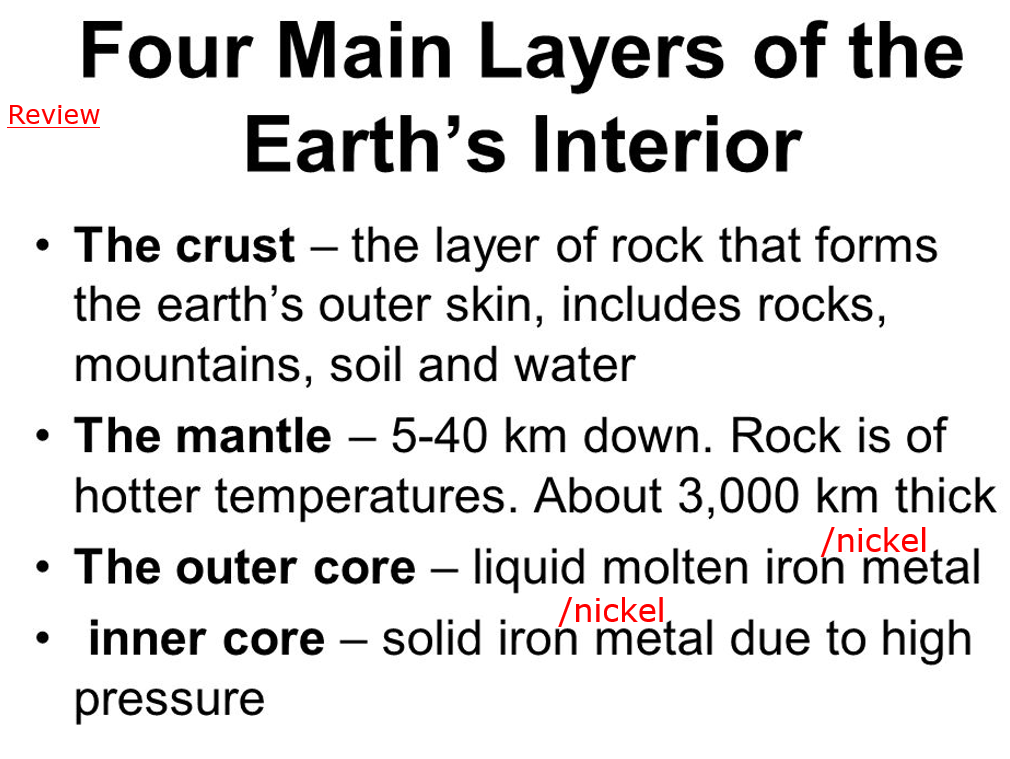
Here is another picture of the Mantle, especially the Upper Mantle, and how it's divided into the lithosphere and asthenosphere (*you can click on the pictures to see them bigger). 

Remember, seafloor spreading can now explain Alfred Wegener's theory of continental drift, because as the seafloor spreads, it pushes away the continents too, causing them to move. This was the mechanism that explained how the continents moved, and supported Alfred Wegener now.


Here are more YouTube videos on this topic: