*This is an excellent video that goes over Independent and Dependent Variables, and it explains why we need to only change 1 variable at a time.
Here's another great video showing the differences between independent and dependent variables:
1) The 1 thing we test, change, or is different between groups in an experiment is the independent variable (we control it!)
2) What we measure or observe at the end is the dependent variable. It's the data we collect.
3) Constants (controlled variables)- Variables that are kept the same, do not change.
TIPS:
Independent variable- "I" change it.
Dependent variable- depends on the independent variable.
Think of Cause (IV) and Effect (DV). The IV comes first (the cause) and the DV comes after (the effect).
So when writing a Hypothesis, the format should be: Ifthe (independent variable) changes, then the (dependent variable) will change because...
Click on the picture below to see it bigger:
Remember, the ONLY variable we change in an experiment is the independent variable. Scientists control all other variables so they can be sure that the results are caused by the independent variable only! This is called a controlled experiment. And it allows the experiment to be fair.
Also, you need to repeat an experiment several times to make sure your results are reliable or valid (accurate).These are called trials. If you do an experiment just 1 time, you might make a mistake or get a strange result.
More Vocabulary: 1) Experimental group- the group that is tested or receives the change. 2) Control group- the group that is not really being tested (gets no special treatment). It's the standard, used for comparison only. 3) Sample size- the total number of people/animals/plants being studied in an experiment. 4) Placebo- a fake pill that contains no active ingredients but is used as a control in testing how well another, real pill works. 5) Trials- the number of times you do a test in an experiment. The more trials you do, the more reliable the experiment is. *A control group is used to see if the change actually works (compared versus the experimental group). *A large sample size is better for an experiment because your results will be more reliable or accurate since you have more data to count on.
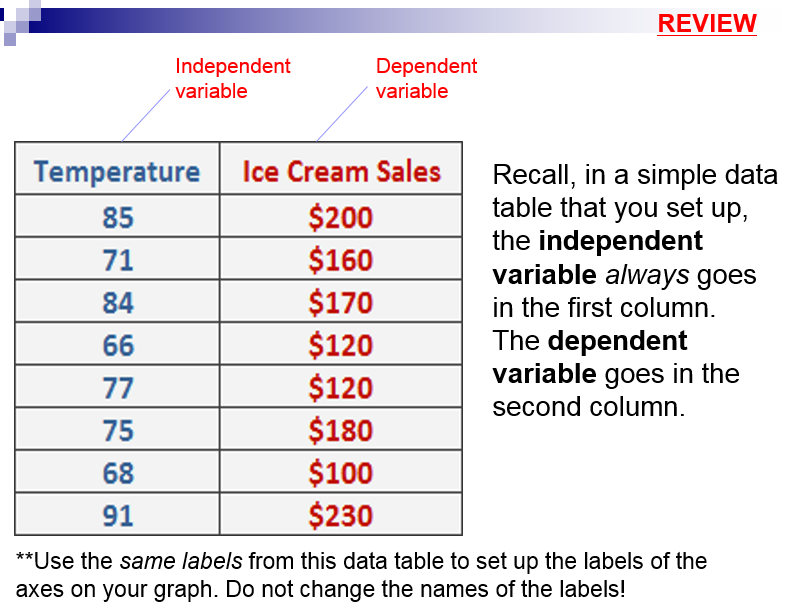
Information on Data tables and Bar Graphs. Click on the pictures to see them bigger:
These are ways to remember where to put each variable on the x- and y- axis, in case you forget:
- Remember to start with a 0 on the scale.
- In order to determine which scale to use, first find the range by taking the largest number in your data table and then subtracting it by the smallest number (ex: 68-22 = 46)
After you find the range, divide it by the number of boxes on the y-axis. Whatever decimal number you get,round it up to the nearest whole number and that is your scale (ex- 1.3 --> 2)
* Here is a link to show more information on bar graphs--> Bar Graph Info
Class, here is a link to a document on how to plan a scientific investigation. It goes over all the steps of the Scientific Method, please review it --> Planning an Investigation Here are some notes from class that are important:
A
question is testable if it can be answered through investigations that involve experiments,
observations, or surveys. You have to be able to observe or measure the collected data.
Effectand
affectare 2
common words used when writing a Research
Question.
•effect-
the result of something (noun)
•affect-
means to influence something (verb)
•Examples: What
is the effect
of drinking toomuch soda? How does working
out affect
your body? Finally, here are good videos that go over the Scientific Method. This first video is excellent because it goes over the steps of the Scientific Method and how the steps can be in a different order sometimes, depending on the experiment itself. Check it out and you'll see what I mean:
This second video is a song that reviews the Scientific Method too:
Class, here is the link to the homework you have to do tonight. Write out the Questions and Answers in your notebook: Sci Method QUIZ 2
nThis
is another Online QUIZ for practice on the Scientific Method.
nKeep
clicking on Next Question Just in case you forgot, here is the link to the first QUIZ from Tuesday: Sci Method QUIZ 1 ff when
you answer each question.
The following website gives a summary of the Scientific Method. It's a good one, read up on it. Click on this link ---> The Scientific Method Explained This is a review of all the steps of the Scientific Method. You can use this information to help you with the Science Fair Project. You can click on the image to see it bigger.
*To make sure you understand the steps of the Scientific Method, take this practice QUIZ:
______________________________________________________ For classes 721, 722, and 728 only: Homework- Click the link on Controls and Variables and do questions 1-15. Write the questions and answers in your notebook. _____________________________________________________ For classes 71A and 71B only: Homework- Click on Scientific Method Stories and answer all the questions for both stories in your notebook. The questions can be restated in your answers. ______________________________________________________ *Everyone should write their HW number in their notebooks.