Showing posts with label Earth Science. Show all posts

Wednesday, January 8, 2020

Plate Tectonics REVIEW

Class, here is a copy of the chart that shows the 3 types of Plate boundaries and their effects. You can click on it to see it bigger. This will be on the test. Study it! The topics for the test are shown below the picture:


This is a link to the video I showed you in class that showed all the animations of the different types of boundaries. Just click on it and look at all the videos on the left-- The Geological Society- Animation Videos on Boundaries
Here's another link that shows you some animations of boundaries-- Exploring Earth- Visualization


These are some notes from class on the 3 boundaries:

- Convergent boundaries
a) When an ocean plate converges with a continental plate, the denser ocean plate slides under the continental plate = Volcanoes or Trench (SUBDUCTION ZONE)
b) When two ocean plates collide, the denser ocean plate slides under the other ocean plate = Volcanic islands or Trench                
(SUBDUCTION ZONE)
c) When two continental plates collide, they crumble up = Mountains

Divergent boundaries

a) When two ocean plates move apart, this causes seafloor spreading = Mid-ocean ridges OR Ocean basins
b) When two continental plates move apart = Rift valleys (a low point)

- Transform boundaries
When two plates slide past each other = Earthquakes


This is more information on the sub-types of Convergent boundaries only. Click on the picture to see it bigger:


Pictures of Boundaries:


These are the topics on the Plate Tectonics test:
- Pangea
- Evidence supporting the theory of Pangea
- Continental drift
- Seafloor spreading
- The names of scientists who developed these theories
- 3 types of boundaries and their effects
- Convection currents (due to density differences)
- VOCABULARY: Lithosphere, Asthenosphere, Mid-ocean ridge, subduction zone, etc.

*You should also know this: Differences in density cause the hot, plastic-like rock to be forced up toward the surface, causing the plates to move.


Also, check out this BrainPop Video again on Plate Tectonics. Do the Review QUIZ to help you study for the Test:
BrainPop- Plate Tectonics


Here are good videos from class- 


Finally, here are additional interactive sites and animation websites that will help you understand the movements of plates and their effects. Also some websites with information on plate tectonics:

Interactives- Dynamic Earth

Earth Guide Online Classroom (Animations + Pics)

Educational Multimedia Visualization Center (click on the Animations)

USGS Educational Videos and Animations

Wednesday, December 4, 2019

Weathering & Erosion VIDEOS

Class, here are several videos on Weathering & Erosion. You can view as many as you want to study or to help you with your homework.


Here is a link to a BrainPop video on Weathering- BrainPop- Weathering  

Here is a link to a BrainPop video on Erosion- BrainPop- Erosion  

Here is another one from BrainPop Jr- BrainPop Jr- Slow Land Changes

And this one is from StudyJams--> Weathering & Erosion

Finally, here's a link to my slides from class on this topic --> Mr Villa's slides on Weathering & Erosion   
And here is a link to another Slideshow that goes over Weathering and Erosion --> SlideShare- Weathering and Erosion


Wednesday, November 27, 2019

Rocks, Minerals, and Rock Cycle- Review for Test

Here's a picture of a T-chart comparing Rocks and Minerals. Click on it to see it bigger:


Pictures of the Rock cycle:


Here's a great video we saw in class on the Rock Cycle:


These are notes on the Rock Cycle:
- Rocks transform over millions of years (slow, gradual process)
- The rock cycle can go in any direction (no beginning or end)
- The 3 types of rocks are dependent on each other through their environment


**These are the topics on the next test:
- Mineral characteristics
- Mineral physical properties (all 6)
- 3 types of Rocks, how they form
- The different kinds of rocks (ex- intrusive, extrusive Igneous rock)
- Rock Cycle

Don't forget, you can also review by watching the BrainPop Videos on the 3 types of Rock, the Rock Cycle, and Minerals. The links to these videos are down below. Again, the username is ps220 and the password is brainpop
Here are the links:


Tuesday, November 19, 2019

Rocks, 3 types explained

Students, these are the detailed notes on the 3 types of Rocks we learned about in class. It will help you understand more about how these rocks formed and how they're different from each other. Click on the pictures to see them bigger:


uRemember, slowly cooling magma inside Earth forms intrusive igneous rock with large crystals.
uFast cooling lava on the outside forms extrusive igneous rock with small or no crystals.


Here is a link to my PowerPoint slides on the 3 types of Rocks --> Slides on 3 types of Rocks

Here is a link to Summary notes on the 3 types of Rocks, it's very detailed (you also got this in class). Check it out --> SUMMARY NOTES ON 3 TYPES OF ROCKS 


And here are some other videos that explain the 3 types of Rocks:


Finally, here's an e-LAB you can do on Mineral properties: GLENCOE LAB- Mineral Properties

Plus a game on Rocks, Minerals, and Soil!!:
Game- Rocks, Minerals, & Soil

Monday, November 11, 2019

Mineral topics for TEST

Class, here is a list of topics on the Minerals test:

- Different ways minerals form
- Characteristics of Minerals
- Physical properties of Minerals and understand each one
- How magma cooling fast or slow affects its crystal size
- Understanding the Mohs hardness scale
- Gemstones


Here is a picture showing some characteristics of Minerals:


Thursday, October 31, 2019

Info on Minerals plus Videos

Class, here are some videos on Minerals and their formation:


Remember, minerals have a crystal structure inside. This means the atoms are arranged in a perfect, repeating pattern over and over.
Here's are pictures of crystal structures for 2 minerals, both of which are made up of Carbon but the atoms are arranged differently:


Also, a mineral's fixed chemical formula might also be stated as having a definite chemical composition. They both mean the same thing, that the elements that make up that mineral are always found in the same ratio throughout the mineral. So for example, in the mineral Fluorite, which has a chemical formula of CaF2, there is always 1 Calcium atom attached to 2 Fluorine atoms, throughout the whole mineral. See the picture below:


Wednesday, October 23, 2019

Videos and Pictures of Earth's spheres and layers (REVIEW)

Class, here are good videos to help you for the next QUIZ. The first one is on Earth's spheres and the second one is on Earth's interior layers. They're short videos. Watch them for practice. Also, don't forget to study about Earth's atmosphere. Remember there is a BrainPop video on Earth's atmosphere. Enjoy!


Earth's System


Here are diagrams of Earth's interior layers and what they are composed of. Click on the pictures to see them bigger:


One last thing, here is an excellent website where you can find more great pictures on Earth's layers and an interactive video too. Just click here--> Layers of the Earth


Tuesday, October 22, 2019

Earth's Interior Layers Explained

Class, these are the notes from today's class on Earth's interior layers:

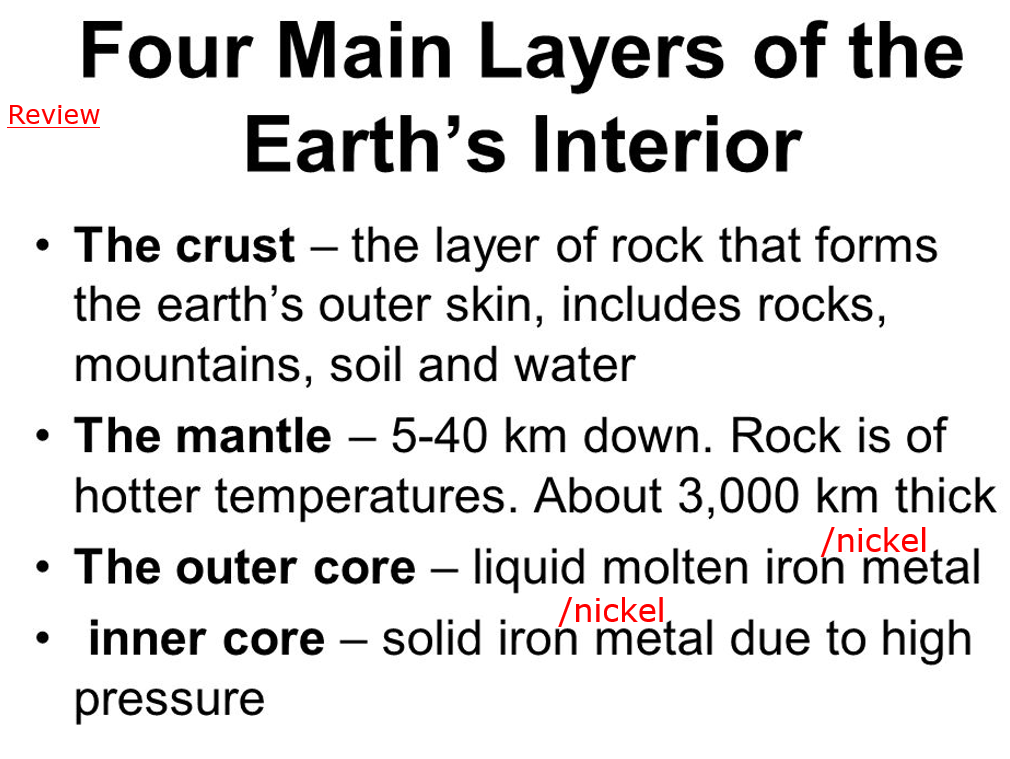
The Crust:
* The Earth’s crust is like the skin of an apple. It is very thin compared to the other three layers.
*The crust makes up 1% of the Earth.
* The crust of the Earth is broken into many pieces called tectonic plates.


The Mantle:
*The mantle is the layer below the crust.
*The mantle is the thickest layer of the Earth, where magma is found.
*The mantle is divided into two regions: the upper and lower sections.


The Outer Core:
* The core of the Earth is like a ball of very hot metals.
* The outer core is liquid.
* The outer core is made up of iron and nickel and is very dense.


The Inner Core:
* The inner core of the Earth has temperatures and pressures so great that the metals are squeezed together and are not able to move.
* The inner core is a solid.


Remember these facts about Models:
- A model is a simulation of a real event or thing.
- A model can be a physical object that is much smaller, more easily observed, or a simplified version of the real thing.
- Models can be mathematical.


HERE ARE SOME VIDEOS ON EARTH'S INTERIOR LAYERS:


Wednesday, January 16, 2019

Upper Mantle (Lithosphere and Asthenosphere) diagrams

Here is another picture of the Mantle, especially the Upper Mantle, and how it's divided into the lithosphere and asthenosphere (*you can click on the pictures to see them bigger). 

Remember, seafloor spreading can now explain Alfred Wegener's theory of continental drift, because as the seafloor spreads, it pushes away the continents too, causing them to move. This was the mechanism that explained how the continents moved, and supported Alfred Wegener now.


Here are more YouTube videos on this topic:


Tuesday, January 15, 2019

Seafloor Spreading

The theory of seafloor spreading states that magma rises at the mid-ocean ridge, pushing the seafloor away as a result. This theory was developed by Harry Hess.
As the seafloor is pushed away, the rocks get younger toward the edges.

Here are diagrams showing seafloor spreading. Click on them to see it bigger:


Thursday, November 1, 2018

Mineral Physical Properties Notes + VIDEOS

Class, these are the notes on Mineral physical properties:

Color- a mineral's color can be observed from its exterior
Hardness- determines how easily a mineral can be scratched (or measures its resistance to scratching).
Streak- the color of the mineral in powdered form on a white tile.
Luster- refers to the way light reflects from the surface of a mineral (ex- shiny, pearly, metallic, dull, glassy).
Cleavage- occurs when minerals split easily along a smooth, flat, parallel surface.
Fracture- occurs when minerals break into pieces with sharp or rough edges.


Also, here is a video that goes over the Physical properties of Minerals. I might have showed some of it to you in class when I first introduced the topic of Minerals:


Here's another one from YouTube that reviews the physical properties of minerals:

Here's an excellent website where you can get more information on Mineral characteristics and properties--> Mineralogy4kids

Extra Credit- Click on the following link to take the QUIZ for homework and write out the Questions and Answers in your notebook-- SoftSchools- Mineral Properties Quiz

Wednesday, October 17, 2018

Earth's 4 spheres (Earth's System)

Class, these are great videos on Earth's 4 spheres, or Earth's system as it's called sometimes. With some of you we saw them in class as well. Take a look again, its an excellent review for your Test:


Watch these videos and include a 4-5 sentence summary in your notebook of what you learned and what was interesting.

Wednesday, December 13, 2017

Homework on Fossils, Friday, December 15

Read more about Fossils and the study of paleontology and write a 2 paragraph summary of new facts you learned, in your own words. Click on this link--> ScienceKids- Fossils


Here's a good link on the Principle of superposition --> Prehistoric Planet

Wednesday, December 6, 2017

Fossils WEBQUEST

Students, go to these websites and copy and answer the questions that follow for each one. First copy the questions down, then look for the answers on the websites. Some are games, some are informational:
1)   
http://fossilsforkids.com/
On this website read the information on fossils, 
including what they are and the types of fossils that exist. Click on the first box that says "I Gotta Question"
Then answer the questions after playing these games and animations:
Questions:
1) What are fossils? Describe in detail. 
2) How are fossils made? Describe the environmental conditions that are necessary to form fossils.
3) Where do you find fossils?

Questions:
1) What is the difference between a mold and cast fossil? Explain.
2) Who are paleontologists and what are the 3 main things they try to figure out about fossils?                                                                                                                              
3) How do paleontologists figure out a fossil's age?

3) Getting into the Fossil Record 
Questions:
1) List 2 questions the fossil record can help us answer.
2) What are 3 types of fossils? Draw one type and label what type it is.
3) How can decomposers affect fossil formation?

4) http://www.neok12.com/Fossils.htm                                         
Scroll down and watch at least 2 videos from this site. Write 1 new fact you learned for each video. Use this website to also view any videos on Fossils that will help you answer the questions above.


5) Draw a picture of a fossil and label it. Explain what type of fossil it is.  

Tuesday, December 5, 2017

Homework on Weathering and Erosion

Class, here is your homework for tonight. Write and answer Questions 1-10 in your notebook. Here is the link to the QUIZ --> Glencoe QUIZ- Weathering and Erosion

Monday, December 4, 2017

Erosion Videos + Formation of Sedimentary Rocks

Here are some videos on Erosion, including one from BrainPop. You will be responsible for what you see from these videos on your next test. Take short notes to remember what you saw:

BrainPop Video- Erosion


Here are some slides from class on the different types of Weathering. Both are useful: